Recently, a few new books have recognized the role
of the System of Rice Intensification (SRI) in global food systems. Most of these publications
call for a shift towards sustainable food production and use SRI
as one example of how to meet growing food needs while safeguarding precious
natural resources. Here are some of the highlights:

This publication looks at the true costs of agricultural
production by analyzing the natural capital impacts to measure
environmental benefits associated with different agricultural management
practices. One case study compares conventional rice cultivation with
organic SRI in India, finding that SRI saves scarce resources and reduces
harmful side effects, all while giving higher yields. This encouraging study
concludes that “the system of rice intensification
offers clear environmental benefits compared to conventionally flooded rice
farming systems in India. The analysis shows that the cost of natural capital
impacts can be reduced by 25 percent largely due to the reduced impacts of land
use change, water consumption and water pollution. There is also a case for
switching farming practices based on economic performance of SRI systems. The
increase in yields and decrease in input costs allowed the gross margin per
hectare to increase by 18 percent for SRI.”

This guide looks at improved practices being applied by smallholder farmers in the developing world for sustainable cereal production. In the SRI chapter, the study looks at how healthy soils lead to healthy plants and higher yields. A special analysis is made of water use, and how SRI’s reduced water requirements can overcome anticipated water constraints in many parts of the world, as well as allow for upland and rain-fed rice production. “From widely-spaced plants in aerated soil, the System of Rice Intensification has produced yields double those of flooded rice fields. Its focus on soil health improves the rice plant’s access to nutrients, while its reduced irrigation needs help cut methane emissions.” There is a discussion of the possible increased labor or job-generating potential of SRI. The authors also note how governments, international organizations, and farmer groups have played a role in supporting SRI’s spread and uptake.
 The author of this book, an
agronomist and journalist for National Geographic magazine, looks at looming
threats to feeding the world’s population, concluding that countries need to
become self-sufficient in food production. SRI and SCI may be one solution:
this “post-modern agriculture” is an alternative answer to the world’s growing
food needs, in contrast to the Green Revolution. One review notes that “SRI has
proven that it can produce more rice with fewer inputs, putting money in
farmer’s pockets while reducing environmental woes. SRI methods have been used
to successfully produce sugarcane, yams, tomatoes, garlic and eggplant.”
The author of this book, an
agronomist and journalist for National Geographic magazine, looks at looming
threats to feeding the world’s population, concluding that countries need to
become self-sufficient in food production. SRI and SCI may be one solution:
this “post-modern agriculture” is an alternative answer to the world’s growing
food needs, in contrast to the Green Revolution. One review notes that “SRI has
proven that it can produce more rice with fewer inputs, putting money in
farmer’s pockets while reducing environmental woes. SRI methods have been used
to successfully produce sugarcane, yams, tomatoes, garlic and eggplant.”
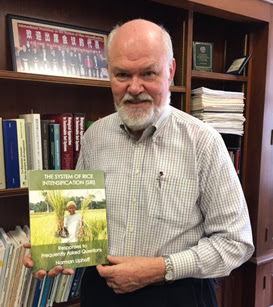
 Authored by SRI-Rice’s own Senior Advisor, this book brings
together Dr. Uphoff’s decades of experience in SRI to address the most
frequently asked questions about this methodology. It is a must-read resource for all
involved in SRI production, research, and promotion. Touching on all the major
principles and applications of this system, the book demonstrates SRI’s many
benefits, including: advantages for women farmers; the potential to reduce
greenhouse gas emissions; possibilities for adapting these methodologies to
numerous agroecological conditions; and the spread of the methods to other
crops, the System of Crop Intensification (SCI).
Authored by SRI-Rice’s own Senior Advisor, this book brings
together Dr. Uphoff’s decades of experience in SRI to address the most
frequently asked questions about this methodology. It is a must-read resource for all
involved in SRI production, research, and promotion. Touching on all the major
principles and applications of this system, the book demonstrates SRI’s many
benefits, including: advantages for women farmers; the potential to reduce
greenhouse gas emissions; possibilities for adapting these methodologies to
numerous agroecological conditions; and the spread of the methods to other
crops, the System of Crop Intensification (SCI).
 This book examines carbon farming,
defined as farming practices that sequester carbon, keeping it out of the
atmosphere. In this global toolkit for carbon farming, SRI’s benefits are
described. Citing a study from Madagascar, the author notes that the “mean
lifetime soil carbon value in SRI fields was more than 150% higher than the
lifetime soil carbon value in conventional fields.” This carbon-sequestering benefit
alongside impressive yield increases frames SRI as a practice that can both
achieve food security and contribute to climate change mitigation.
This book examines carbon farming,
defined as farming practices that sequester carbon, keeping it out of the
atmosphere. In this global toolkit for carbon farming, SRI’s benefits are
described. Citing a study from Madagascar, the author notes that the “mean
lifetime soil carbon value in SRI fields was more than 150% higher than the
lifetime soil carbon value in conventional fields.” This carbon-sequestering benefit
alongside impressive yield increases frames SRI as a practice that can both
achieve food security and contribute to climate change mitigation.


This guide looks at improved practices being applied by smallholder farmers in the developing world for sustainable cereal production. In the SRI chapter, the study looks at how healthy soils lead to healthy plants and higher yields. A special analysis is made of water use, and how SRI’s reduced water requirements can overcome anticipated water constraints in many parts of the world, as well as allow for upland and rain-fed rice production. “From widely-spaced plants in aerated soil, the System of Rice Intensification has produced yields double those of flooded rice fields. Its focus on soil health improves the rice plant’s access to nutrients, while its reduced irrigation needs help cut methane emissions.” There is a discussion of the possible increased labor or job-generating potential of SRI. The authors also note how governments, international organizations, and farmer groups have played a role in supporting SRI’s spread and uptake.
3. The End of Plenty: The Race to Feed a Crowded World, Joel K. Bourne Jr.
The author of this book, an
agronomist and journalist for National Geographic magazine, looks at looming
threats to feeding the world’s population, concluding that countries need to
become self-sufficient in food production. SRI and SCI may be one solution:
this “post-modern agriculture” is an alternative answer to the world’s growing
food needs, in contrast to the Green Revolution. One review notes that “SRI has
proven that it can produce more rice with fewer inputs, putting money in
farmer’s pockets while reducing environmental woes. SRI methods have been used
to successfully produce sugarcane, yams, tomatoes, garlic and eggplant.” Authored by SRI-Rice’s own Senior Advisor, this book brings
together Dr. Uphoff’s decades of experience in SRI to address the most
frequently asked questions about this methodology. It is a must-read resource for all
involved in SRI production, research, and promotion. Touching on all the major
principles and applications of this system, the book demonstrates SRI’s many
benefits, including: advantages for women farmers; the potential to reduce
greenhouse gas emissions; possibilities for adapting these methodologies to
numerous agroecological conditions; and the spread of the methods to other
crops, the System of Crop Intensification (SCI).
5. The Economics of Ecosystems and Biodiversity (TEEB) for Agriculture and Food: Interim Report, United Nations
Environment Programme
This publication looks at
“eco-agri-food systems,” defined as sustainable food systems that can ensure
food security now and in the future that will secure improved well-being and
livelihoods. An academic literature review and biophysical modeling were used
to compare rain-fed SRI to conventional rice cultivation in various
rice-producing countries, with impressive results. The study finds incredible
gains in countries around the world: in Senegal, “switching to SRI…could save
around $11 million/annum in water consumption related health and environmental
costs, and at the same time the rice producing community would gain around
US$17 million through yield increases… If the Philippines were to change all
their rain-fed lowland systems from conventional management to SRI, the rice
producer community would gain a total of US$750 million through yield
increases. No water consumption costs result from this farming system as it is
dependent on rainfall only…This is one of many examples of win-win outcomes.”
6. The Carbon Farming Solution, Eric Toensmeier
This book examines carbon farming,
defined as farming practices that sequester carbon, keeping it out of the
atmosphere. In this global toolkit for carbon farming, SRI’s benefits are
described. Citing a study from Madagascar, the author notes that the “mean
lifetime soil carbon value in SRI fields was more than 150% higher than the
lifetime soil carbon value in conventional fields.” This carbon-sequestering benefit
alongside impressive yield increases frames SRI as a practice that can both
achieve food security and contribute to climate change mitigation.