Friday, March 30, 2012

INDIA: SRI Concepts Applied to Direct-Seeded Rice in Andhra Pradesh

As an "open source" climate-smart innovation, the System of Rice Intensification (SRI) is intended to be modified by users.   While originally developed for transplanted, irrigated rice, SRI principles have been adapted to fit both farmer needs and the agroecosystem. One adaptation, which  involves direct-seeding rice with a drumseeder, is being promoted by the Rashiya Seva Samithi Acharya Ranga Krishi Vigyan Kendra (RASS-KVK) in Tirupati, Chittoor district, Andhra Pradesh, India.

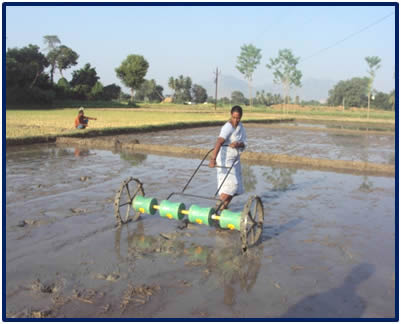
RASS-KVK began experimenting with the drumseeder SRI adaptation for direct-seeding in 2006; by 2011, 658 farmers are using the method on 1,220 acres in Chittoor district.  Direct seeding with a lightweight drumseeder (shown at left) can reduce labor and time requirements through eliminating nursery-raising and transplanting, and results in a uniform plant population that matures earlier by 7-10 days. Comparison of the modified SRI method with traditional methods in Chittoor showed the average yield was higher (12%), cultivation costs were lower (by 25%), gross returns were greater (10%), and net returns were much higher (76%) with the direct-seeding.


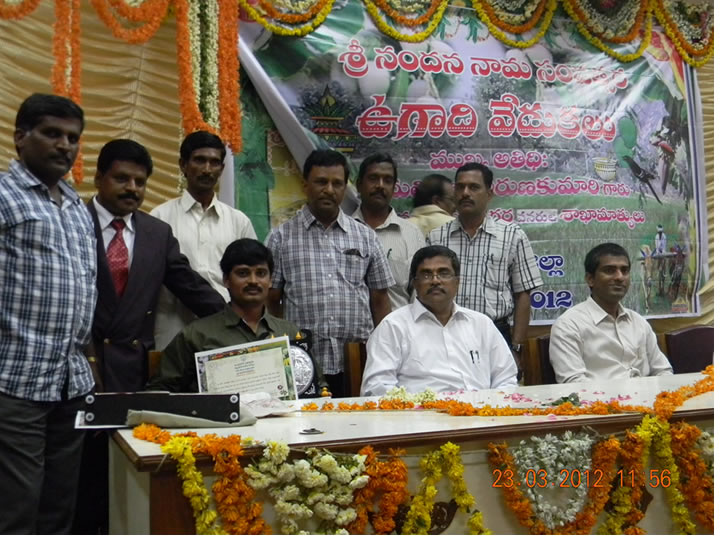
On February 23, 2012, Nageswar Rao (right) , the first person to adopt the modified SRI drumseeder method in his area, received the Best SRI Farmer Award for the Chittoor district of Andhra Pradesh. For more information on using the RASS-KVK direct seeding method, see the SRI-Rice feature article which includes videos and an updated report by P. Bala Hussain Reddy, S. Sreenivasulu and C. Manohar.
 

Monday, February 20, 2012

KENYA: SRI Adoption and Yields on the Rise

Bancy Mati at SRI harvest According to Bancy Mati (at left), the driving force behind SRI promotion and research in Kenya and professor at Jomo Kenyatta University of Agriculture and Technology (JKUAT), the System of Rice Intensification (SRI) is now well-accepted just two and a half years after the practice was introduced into Mwea Irrigation Scheme. Approximately 3,000 farmers have been trained in SRI methods and adopters now number about 2,000 in the four irrigation schemes (Ahero, West Kano, Bunyala and Mwea). Mati estimates that thousands more have been reached through radio broadcasts (also in local languages), newspaper articles, exhibitions and open days sponsored by the JKUAT open days.

 This 2011-2012 season has shown good results with yields: Up to 9 t/ha for the lower-yielding Basmati variety compared to 5 t/ha with conventional management and over 17 t/ha for a high-yielding IR variety compared to 9 t/ha without SRI practices. Research findings also indicate water savings ranging from 25% in dry weather to 33% in wet weather. Several graduate theses have proven the benefits of SRI and additional research is underway by graduate students and staff of JKUAT, Mwea Irrigation Development Centre (MIAD), and recently Moi University. MSc research has also shown that show that SRI water management breaks the mosquito breeding cycle, showing good prospects for malaria control!

Kenyan farmers as well as other rice stakeholders are excited about SRI. A bag of SRI paddy reportedly weighs 10-20 kg more than that of conventional rice, mostly because of greater grain filling (fewer unfilled grains). When milled, the SRI rice has more whole grains (less breakage) so it sells faster, sometimes earning KSh2/kg (˜2.5¢/kg) more than conventional rice.

As part of the regular training to reach the unreached, an SRI field day was held  in Mwea on January 30, 2012. The training was conducted almost entirely by several of the 115 farmers who have completed the Training of Trainers (ToT) course. [Read more in the Kenya Feature on the SRI-Rice website.]

Wednesday, February 8, 2012

SRI LANKA: Evidence of Flood Resistance in SRI Paddies

It is not unusual to hear reports of rice fields planted with System of Rice Intensification (SRI) methods that do not lodge (fall over) in inclement weather or that can resist drought when the rains disappear. These positive outcomes are, at least in part, attributed to stronger, deeper roots that result from SRI practices. Now, reports from Sri Lanka suggest that SRI fields can be less susceptible to flood damage as well. Farmers in the north central region noticed that the paddy fields under SRI cultivation had not suffered as severely during recurring floods as per the experience in the northeast. According to an Oxfam Australia (OAU) report, this helped renew interest in SRI during 2010/2011. The report further mentions that research in Sri Lanka linking arsenic-related health problems to agricultural chemicals used in rice production have spurred an additional interest in organic SRI. (See Feb. Feature item for more information on this and the SRI Network in Sri Lanka).


As SRI generates more positive results, SRI network partners have been featured in newspaper articles, radio broadcasts and telecasts. Chaminda Fernando at OAU in Sri Lanka forwarded us several of these stories. Mohommed Ismail Rizana (at right), a woman farmer in Ampara District, achieved almost 80 bushels of rice with organic SRI methods, a 45% increase over average rice yields in the area (see full story).  R. M. Heenmenike, originally tried SRI in 2008 to save water. After her success in adopting organic SRI methods, she has become a volunteer SRI trainer and has been featured in newspaper articles and a video. (Read Heenmenike's story.)

Monday, January 30, 2012

AFGHANISTAN: Raising Yields with the System of Rice Intensification

According to the Aga Khan Foundation - Afghanistan (AKF-A) SRI final report for 2011, 114 farmers, including seven resource persons (RP) and twenty new volunteers, have been applying System of Rice Intensification methods for rice cultivation in two districts of Baghlan and Takhar provinces, as part of the Participatory Management of Irrigation Systems (PMIS) project, managed by AKF. The project is part of the larger government-led Panj-Amu River Basin Program (PARBP), which is funded by the European Union.

DAIL and RP taking field measurements in the field In both districts (Doshi in Baghlan Province and Taloqan in Takhar Province), the average results clearly show a net improvement in SRI yield compared to the yield with the traditional practices (10.01 t/ha with SRI vs. 5.04 t/ha with traditional methods -- an average combined yield increase of + 49.65% for both districts.)

You can read more about SRI progress in Afghanistan in this week's Featured Item on the SRI-Rice website.